
Redwood County Bench Warrants Explained
A bench warrant in Redwood County is a judge's order that follows an obligation a person did not meet. The trigger is usually a missed appearance. Skipping a scheduled jail report date counts too. The Sheriff's reporting page states plainly that a warrant follows that failure. Some states call this paper a capias. Minnesota does not. Court papers here read warrant, bench warrant, arrest warrant, or failure-to-appear warrant. A document from another state may still say capias, so ask the issuing court what that label means for the case. Note: the label on the paper drives what happens next, so read it closely before you act.
Redwood County Failure-to-Appear Triggers
Most bench warrants in Redwood County trace back to four situations. A hearing in a criminal case gets missed. A summons or a citation goes unanswered. A sentencing date at the jail arrives and the person does not report. Or some other condition the court ordered simply is not met. Traffic cases follow their own path. The state's pay-a-fine guidance gives a citation 30 days from filing to be paid or set for appearance, and it warns that a warrant, penalties, and licensing consequences can follow if that deadline slips.
How Redwood County Bench Warrants Are Issued
Minnesota's criminal rules let a judge issue a warrant when someone fails to respond to a summons or citation. The request itself runs on Minnesota Form 8. The judge signs the order. The warrant names the person and the offense. It also states the bail or release conditions the judge sets. A Redwood County prosecutor can request a warrant mid-case when the facts and a risk assessment support one, as the county's criminal justice overview explains. Either way the court order is the authority. The docket shows it.
Redwood County Sign-and-Release Warrants
Not every failure-to-appear warrant in Redwood County ends in an arrest. Minnesota law creates a sign-and-release process for certain cases. An officer gives a new notice, not custody. The warrant is then treated accordingly. Nothing on the county list tells you which type you face. Ask the person at the court or the Sheriff's Office, or read the order itself.
Key point: Minn. Stat. section 629.415 describes the sign-and-release process, so a bench warrant label alone does not prove an arrest is authorized.
Bench Warrants and Arrest Warrants Compared
The two labels mark different starting points in Redwood County. A bench warrant grows from a case already in court. An arrest warrant usually starts one, after charges and a judge's finding of probable cause.
| Point | Bench warrant | Arrest warrant |
|---|---|---|
| Typical trigger | Missed appearance or unmet obligation | Charges filed with probable cause |
| Case status | Case already open in court | Often the beginning of the case |
| Court contact | Court Administration holds the file | Court Administration holds the file |
| Release pattern | May follow the sign-and-release statute | Bail or bond conditions stated on the warrant |
Redwood County Form 8 Warrant Requests
Minnesota publishes its criminal procedure forms, and Form 8 is the application for a warrant after a failure to respond to a summons or citation. A prosecutor files it after a missed appearance. Most readers never need the form itself. What matters is that the missed appearance got documented. That is why Court Administration asks for two details first. The citation number and the hearing date anchor any Redwood County warrant question.
Resolving a Redwood County Bench Warrant
Start with the court, not the jail. Court Administration can say whether the Redwood County case needs a hearing, a payment, a motion, or another appearance, and whether the warrant follows the sign-and-release statute. For agency-side steps, call the Sheriff's Office at 507-637-4036. Identification questions go there too. A lawyer can explain the options and file what the court requires. Court-appointed counsel may be an option. The state law library lists a Fifth Judicial District public defender office in Marshall for criminal and juvenile cases.
Caution: Paying a traffic citation does not by itself recall a bench warrant. Ask the court how compliance is reported before you assume the matter is closed.
Motion Fees and Redwood County Warrants
Filing a motion costs money. The Judicial Branch lists a $75 base fee for a motion or response in district court. A county law library fee may apply. A fee reduction or waiver may be available to people who qualify. Budget for it before you file. The Minnesota district court fees schedule sets out what a motion in a Redwood County warrant case costs.
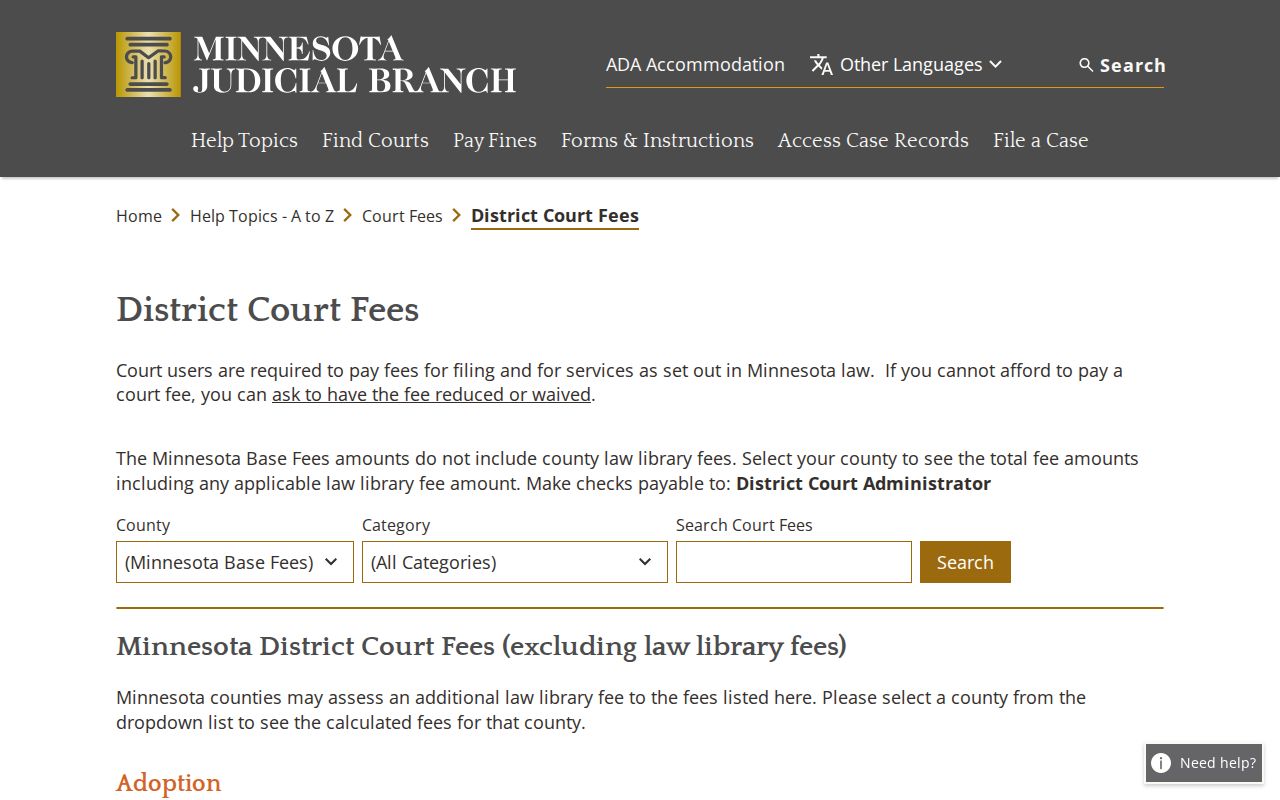
Check with Court Administration first. A motion is not always required to resolve a Redwood County bench warrant, since many end with an appearance or a payment instead.
Finding the Court That Issued the Warrant
One trial court serves this county. Redwood County District Court, part of the Fifth Judicial District, sits in Redwood Falls and hears criminal, traffic, civil, family, probate, and juvenile matters. No separate municipal or justice-of-the-peace court keeps its own warrant counter. City police still enforce their ordinances and write citations, but those cases land in the same district court. To visit, pull up the court finder entry for Redwood County, which lists the address and hours. Note: If a notice names a different county, that county's court holds the file, no matter where the person lives.
Redwood County Bench Warrant Copies
Court Administration handles the copies. A request can go to the counter, travel by mail, or move through eFile where that route is permitted. The Judicial Branch publishes the current options for each method. An uncertified copy is generally free. A certified copy carries a fee. Pay it by card, check, or money order. Records the county itself holds, such as sheriff publication data, follow the Minnesota Government Data Practices Act request process, so ask for a defined record and a date range rather than a new report. Note: Redwood County publishes no form for a motion to recall or quash, so ask the court which motion applies before filing anything.